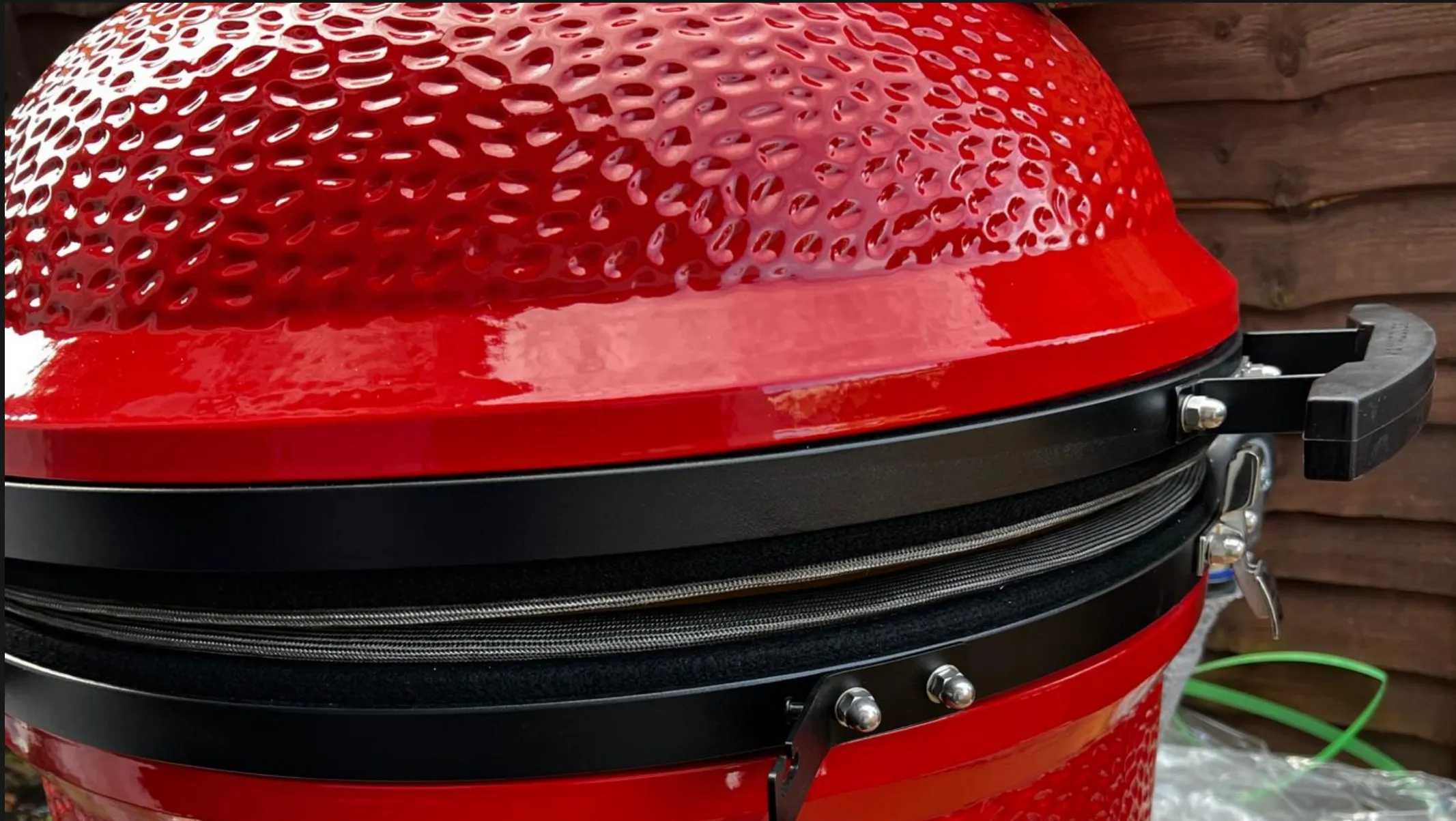
Low-Carb BBQ: A Guide to Kamado Cooking in the UK
Why BBQ is one of the most naturally low-carb ways to cook, how to avoid the sugar traps, and what I've learned from three years with a Kamado Joe Big Joe II — including the accessories worth having.
Published
BBQ is one of the most naturally low-carb ways to cook. When you strip it back to what it actually is — whole cuts of meat, live fire, time, and smoke — there are no carbohydrates involved. A smoked brisket straight off the kamado has zero carbs. A rack of pork ribs with a dry rub has zero carbs. Even a slow-roasted leg of lamb has zero carbs. The problems start with what people put on top and alongside.
I’ve been cooking on a Kamado Joe Big Joe II (Ad) for about three years now. I paid 1,350 pounds for it, and it’s probably the best cooking purchase I’ve ever made. There are cheaper ways to barbecue. There is not a better way to barbecue — at least not within a reasonable budget. This guide covers why low-carb and BBQ are such a natural fit, the traps to avoid, and what I’ve learned about the kit.
Why traditional BBQ is inherently low-carb
Authentic live-fire cooking — smoke roasting, direct searing, low-and-slow smoking — is built around whole animal proteins. Unlike almost every other culinary tradition, it doesn’t rely on flour, pasta, breadcrumbs, or starchy thickeners to develop flavour. The crust that forms on a brisket (the “bark”), the rendered fat from slowly cooked pork ribs, the smoke ring that develops three centimetres into a well-cooked flat — all of that comes from the interaction of protein, fat, fire, and time. No carbohydrates required.
The macros for core BBQ cuts are clean:
| Cut | Protein per 100g | Fat per 100g | Carbs per 100g |
|---|---|---|---|
| Beef brisket (smoked) | 27g | 10g | 0g |
| Beef short ribs (smoked) | 22g | 15g | 0g |
| Pork shoulder / pulled pork | 20g | 12g | 0g |
| Pork ribs (unglazed) | 20g | 14g | 0g |
| Chicken thighs (skin-on, smoked) | 24g | 15.5g | 0g |
| Lamb shoulder (smoked) | 23g | 16g | 0g |
All zero. The moment you apply a commercial BBQ sauce, it changes entirely.
The sugar problem: commercial BBQ sauces
This is the biggest single trap in BBQ for low-carb eating. Commercial BBQ sauces are essentially sugar delivery mechanisms — they use refined sucrose, glucose-fructose syrup, molasses, and honey to balance the acidity of vinegar and the umami of tomato. The numbers are startling:
| Sauce | Carbs per 100g | Sugars per 100g |
|---|---|---|
| Bull’s-Eye Original BBQ Sauce | 52.6g | 47.4g |
| HP Classic Woodsmoke Sauce | 31.5g | 24.0g |
| Heinz Classic Barbecue Sauce | 34.0g | 29.0g |
| HP Honey Woodsmoke BBQ Sauce | 30.6g | 24.2g |
Two tablespoons of Bull’s-Eye contains roughly 20g of carbohydrates — an entire day’s allowance on a strict ketogenic diet. Applied as a glaze over the last half-hour of a cook, a rack of ribs that was zero-carb becomes a high-sugar meal.
What to use instead:
Hunter & Gather Unsweetened Smokey BBQ Sauce is the best option I’ve found in the UK. It’s made from organic tomatoes, apple cider vinegar, balsamic vinegar, and smoked water — no added sugar, no sweeteners. It comes in at 9.9g carbohydrates per 100g, almost entirely from naturally occurring tomato sugars, which is a 75% reduction compared to Heinz. I use it regularly. Worth hunting out.
Dry rubs are the better answer. For serious BBQ, I mostly skip sauce entirely and rely on the rub and the bark. A low-carb rub is simple: 50/50 coarse black pepper and kosher salt for beef (the classic Texas “Dalmatian rub”), or layered with smoked paprika, garlic powder, onion powder, ground celery seed, and English mustard powder for pork and chicken. If you want the hint of sweetness that brown sugar usually provides, granular erythritol or a monk fruit blend works well and doesn’t burn at low smoking temperatures.
Chimichurri and herb butters make excellent low-carb finishers. A compound butter (roasted garlic, parsley, lemon zest) melting over a rested steak or rack of ribs provides richness, moisture, and flavour with zero carb impact.
The UK sausage problem
Worth a specific mention: traditional British sausages are not the same as many European or American equivalents. The classic UK banger relies heavily on wheat rusk as a binder — up to 5 to 10g of carbohydrates per sausage from filler alone.
The safe options for low-carb BBQ:
- The Black Farmer Premium Pork Sausages — 90% British pork, gluten-free, no wheat rusk. Widely available in supermarkets.
- Heck 97% Pork Sausages — very high meat content, no starchy fillers.
- Asda Extra Special Classic Pork Sausages — 90% pork, 2.2g carbs per 100g.
Always read the label on sausages. “Premium” doesn’t automatically mean low-carb.
Why a kamado, and why the Big Joe
I came to the Kamado Joe from a standard steel kettle BBQ. The difference in what you can cook, and how reliably you can cook it, is not marginal. It’s a different category of tool.
The fundamental advantage of a ceramic kamado is thermal efficiency. The thick cordierite ceramic walls act as a thermal battery — once the dome is fully heated, it holds that energy and radiates it evenly as infrared heat. Because almost no heat escapes through the walls, the vents are barely open during a low-and-slow cook: a few millimetres on the bottom draft door and the top Kontrol Tower. This drastically reduced airflow traps the moisture evaporating from the meat inside the sealed dome. The result is better-hydrated meat, remarkably stable temperatures, and minimal fuel consumption.
For UK conditions specifically — cold, wet, often windy — this matters enormously. A ceramic kamado holds 110 degrees C through a February overnight cook without intervention in a way that a metal smoker simply cannot.
I went straight to the Big Joe II (Ad) rather than the Classic Joe because I wanted the 24-inch cooking area. If you’re cooking for a family or entertaining, the larger grate makes a significant difference — you can run a full brisket flat alongside a rack of ribs with room to spare. I paid 1,350 pounds about three years ago. Current UK retail for the Big Joe II is around 1,999 pounds; the Big Joe III (which includes the SloRoller as standard) is approximately 2,899 pounds.
The main competitors worth knowing about:
Big Green Egg — the original premium kamado brand with exceptional build quality and a devoted community. The significant downside is the pricing model: the Egg is sold bare, without a stand, without the ceramic heat deflectors, without side shelves. By the time you’ve bought the essentials, you’ve spent considerably more than the list price suggests. Kamado Joe includes these components as standard.
Monolith — German-engineered, outstanding build quality, with a unique integrated wood-chip feeder that lets you add smoking wood without opening the dome. The Classic retails around 1,099 pounds, making it strong value. Worth serious consideration.
Gozney Dome — a different category. Brilliant for extreme-heat pizza. Not a serious contender for long low-and-slow BBQ cooks.
The accessories I’ve bought and what I think of them
Gas torch — an essential fire starter
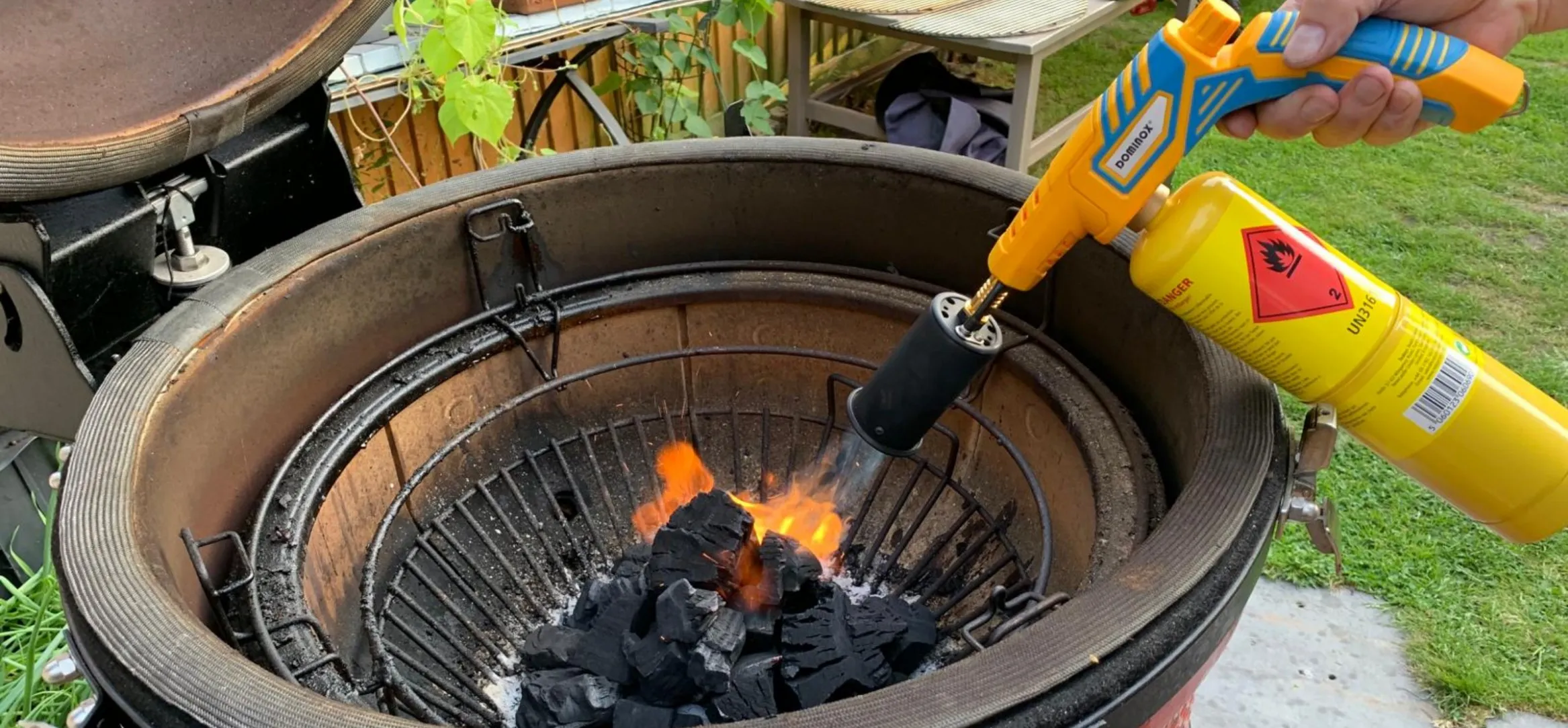
This is one of my most-used and most-loved pieces of kit. A propane torch connected to a standard canister gets the kamado coals burning in 30 to 60 seconds flat. No chemicals, no firelighters, no waiting around. I use this to start every single cook. If you get a kamado, get one of these on day one. View the DOMINOX Cooking Torch on Amazon (Ad)
One note on gas: I tried standard Coleman canisters first but they didn’t provide enough pressure for a strong, sustained flame. I now use Mapp Gas Pro Plus canisters (Ad) — they burn significantly hotter than propane and give a reliable ignition point every time.
The JoeTisserie rotisserie — highly recommended
The JoeTisserie is one of my most-used accessories. It’s a cast-aluminium ring that sits between the base and dome, housing a 240V UK-plug motor that slowly rotates the spit. The self-basting effect of continuous rotation produces the best whole chicken I’ve ever cooked — the rendered fat continuously bastes the exterior while the interior stays moist. Whole chicken, legs of lamb, pork shoulder — anything that benefits from even cooking and self-basting works brilliantly on this. View the JoeTisserie on Amazon (Ad) — approximately 319 pounds.
Thermapen ONE — essential
The Thermapen ONE is the industry standard instant-read meat thermometer, and I use it on every single cook. It gives an accurate reading in under one second, which matters when you’re checking multiple probing points across a brisket flat or confirming a chicken thigh has hit temperature. For serious BBQ, a good instant-read probe is not optional — guessing internal temperature is how you ruin expensive cuts of meat. View the Thermapen ONE on Amazon (Ad) — approximately 78 pounds.
MEATER Pro smart thermometer — essential for long cooks
I have the older MEATER Plus, but the current model to buy is the MEATER Pro (Ad) — lab-certified accuracy, improved range and connectivity, and the same core concept that makes wireless leave-in probes essential for kamado cooking.
The MEATER Pro tracks both the internal meat temperature and the ambient cooker temperature simultaneously, sending data to your phone via Bluetooth and WiFi. For long low-and-slow smokes — overnight brisket cooks, pork shoulders that run 12 to 15 hours — being able to monitor both the fire and the meat from your phone without opening the dome is genuinely invaluable. It removes the anxiety from long cooks and lets you sleep, watch TV, or sit in the garden without constantly checking the kamado. An essential item.
Kamado Joe Soapstone Cooking Surface — excellent but niche
The soapstone sits in the Divide and Conquer rack and provides a completely flat, very dense cooking surface. It retains heat extraordinarily well and cooks differently to the standard grates or cast iron — a very gentle, even sear rather than aggressive grill marks. I use it mainly for fish and scallops, where the gentle contact heat of the stone is far kinder than the direct infrared of the grates. If fish is part of your BBQ repertoire, this is worth having. View the Soapstone on Amazon (Ad) — less essential if you’re primarily cooking meat.
Kamado Joe Big Joe Cover — essential
Not just for rain — UV exposure in a UK summer will bleach the red ceramic over time without a cover. Mine has faded from black to white over the past couple of years, but it is still doing its job. The custom-fitted Kamado Joe cover is solution-dyed and properly waterproof. View the Big Joe Cover on Amazon (Ad) — approximately 85 pounds.
Kamado Joe Ceramic Chicken Cooking Stand — useful
Effectively a ceramic beer-can chicken holder. It allows a whole chicken to cook upright in the dome, which promotes even heat circulation and a crisper skin than laying flat. Good results, very easy to use. Worth the low cost. View on Amazon (Ad)
Onlyfire Ash Basket (third-party) — good practical upgrade
The primary reason to upgrade from the standard Kamado Joe basket is airflow. The Onlyfire basket has larger, better-spaced gaps in the base that allow significantly more air to circulate through the charcoal bed — easier lighting, more responsive temperature control, and cleaner ash fall-through. Not an exciting purchase but one I’d buy again. View on Amazon (Ad)
MEATER Mitts heat-resistant BBQ gloves — essential
The kamado dome runs at serious temperatures. A standard tea towel is not appropriate protection. These gloves protect to high temperatures and allow you to confidently handle the dome lid, adjust grates, and move meat without burns. I use them every cook. View on Amazon (Ad)
Recommended Kamado Accessories
(Ad)onlyfire Charcoal Ash Basket — Fits Kamado Joe & Big Green Egg
Stainless steel basket improves airflow and makes ash cleanup significantly easier.
(Ad)MEATER Mitts Heat Resistant BBQ Gloves
Extra-long cuffs and non-slip grip. Essential for handling hot grates and chimneys safely.
(Ad)Kamado Joe Big Joe JoeTisserie
Official rotisserie attachment for the Big Joe. Whole chicken and lamb shoulder on the kamado.
(Ad)Kamado Joe Big Joe Soapstone Cooking Surface
Retains heat evenly for searing. Excellent for fish and delicate proteins that stick to grates.
The iKamand warning
If you see an iKamand — Kamado Joe’s WiFi smart temperature controller — for sale anywhere: do not buy it. In July 2023, the third-party software company running the servers abruptly shut down and removed the app from app stores. Every existing iKamand unit became unusable immediately. Old stock still surfaces on eBay and secondary markets. Avoid.
The Kontrol Board (the newer digital interface) is integrated into the Konnected Joe series and is not available as a retrofit accessory for standard Big Joe models.
Charcoal for a kamado
A kamado must only be fuelled with 100% natural lumpwood charcoal. Never standard briquettes — they contain binders, coal dust, and accelerants that produce acrid smoke and generate excessive ash that blocks the airflow grate.
My two go-to recommendations:
Kamado Joe Big Block Premium Lump Charcoal 9kg (Ad) — the obvious first choice for a Kamado Joe owner. Kamado Joe’s own branded charcoal uses very large, dense hardwood chunks specifically sized and graded for kamado use. The big pieces burn slowly and steadily, making them ideal for the long low-and-slow cooks that a kamado excels at. It’s what I primarily use and I trust the consistency.
Globaltic 10kg Birch Lumpwood Charcoal (Ad) — highly recommended to me by a friend who is an experienced pitmaster, and it’s become a firm favourite. Restaurant-grade birch lumpwood with a notably clean burn, high heat output, and very low ash production. The birch provides a neutral, clean smoke that doesn’t interfere with your smoking wood pairings. Excellent value.
Never use lighter fluid or petroleum-based firelighters inside a kamado. The porous ceramic permanently absorbs the petrochemicals and taints all future cooks.
Smoking wood pairings
The smoke is a flavour ingredient, not just a byproduct. UK suppliers like ProSmoke, Woods Direct, and the Oxford Charcoal Company all stock a good range.
| Wood | Profile | Best pairings |
|---|---|---|
| Oak | Medium-strong, deeply savoury | Beef brisket, beef short ribs — essentially mandatory |
| Cherry | Mild, slightly sweet, beautiful colour | Pork ribs, pork shoulder, chicken |
| Apple | Gentle, mellow, very forgiving | Whole chicken, chicken thighs, pork loin |
| Hickory | Strong, bacon-like intensity | Pork — use sparingly or blend |
| Whisky barrel | Earthy, vanilla-laced oak from aged casks | Premium brisket, thick steaks |
For the UK specifically, whisky barrel chunks from Speyside and Highland casks are a particularly good find — available from specialist suppliers and worth using on a premium brisket. The faint spirit character in the smoke is genuinely distinctive.
Bury wood chunks slightly within the unlit charcoal rather than placing them on top. Restricting their oxygen causes the wood to smoulder slowly, producing thin blue smoke rather than billowing white smoke. Thin blue smoke is what you want. White smoke is bitter.
The stall: what it is and how to handle it
Every new low-and-slow cook hits the stall and panics. When a large piece of meat (brisket, pork shoulder) reaches about 71 degrees C internally, the temperature stops climbing and can plateau for two to six hours. It feels like the fire has died.
It hasn’t. The stall is caused by evaporative cooling — the meat is sweating moisture onto its surface, and that evaporation is cooling the exterior at exactly the rate the kamado is heating it. The thermal equilibrium is almost perfectly balanced.
The fix is the Texas Crutch: wrap the meat tightly in unwaxed peach butcher paper or heavy-duty foil the moment it hits the stall. The wrap traps the humidity at 100%, evaporation stops, and the temperature climbs past the plateau. Butcher paper is preferred over foil because it breathes slightly, preserving more bark texture. Foil is more aggressive but faster.
For brisket and pulled pork, the target internal temperature is 93 to 96 degrees C — not the 75 degrees C the UK Food Standards Agency specifies as the minimum safe temperature. At 75 degrees C, brisket is safe but completely inedible — the collagen hasn’t melted yet. The FSA threshold is a safety minimum, not a doneness guide. At 93 degrees C and above, the meat is safe, the collagen has converted to gelatin, and the meat pulls apart effortlessly.
Low-and-slow setup on the Big Joe
- Fill the charcoal basket generously with large lumpwood chunks
- Light the fire in only one small spot using the gas torch (30 to 60 seconds)
- Bury your smoking wood chunks into the unlit coal
- Insert the ceramic half-moon heat deflectors, then the cooking grates
- Set the bottom draft door to approximately 3 to 5mm open
- Set the top Kontrol Tower to a small sliver
- Let the temperature rise slowly to your target (107 to 120 degrees C)
- Stabilise at temperature for 20 to 30 minutes before adding meat
Do not rush the startup. A kamado that climbs to temperature slowly is far easier to hold stable than one that has overshot and needs to be choked back down. Ceramic holds temperature in both directions — an overheated dome takes a long time to cool.
BBQ Cooking Fats
(Ad)Hunter & Gather Organic Beef Tallow 450g
Rub onto brisket, short ribs or lamb before the kamado. High smoke point, exceptional flavour.
(Ad)Hunter & Gather Organic Ghee 450g
Baste chicken and pork cuts during the cook. Grass-fed British cows, seed oil free.
UK BBQ community resources
Meat & Greet BBQ Podcast (Owen and Dan) — the definitive UK BBQ podcast, with over 88 episodes covering equipment, technique, and interviews with competition pitmasters. Required listening.
Smoking Dad BBQ (YouTube, Canadian) — technically not UK-based, but globally recognised as the most authoritative channel specifically on Kamado Joe operation: precise vent settings, the physics of the dome, technique for every cook. Mandatory viewing for any serious Big Joe owner.
Jack’s Meat Shack (YouTube, UK) — high-quality content tailored to British enthusiasts, equipment reviews, and recipes using UK-available cuts and ingredients.
Smoke and Fire Festival — Maldon, Essex, August 2026 (10th anniversary edition). The UK’s premier family BBQ festival, featuring the Great British Open Freestyle BBQ Championships.
Recommended UK BBQ books:
Genevieve Taylor (Charred, Scorched, Foolproof BBQ) — the most rigorous scientific approach to live-fire cooking written for a UK audience. Runs the Bristol Fire School. Her books dissect the thermodynamics of charcoal cooking in a way that makes you meaningfully better.
Christian Stevenson / DJ BBQ (Fire Food) — broader, more exuberant, covers everything from low-and-slow to dirty cooking (directly on the coals). A staple.
The BBQ accessories mentioned in this guide are all on my Amazon Recommendations page — affiliate links help keep the site running at no extra cost to you.