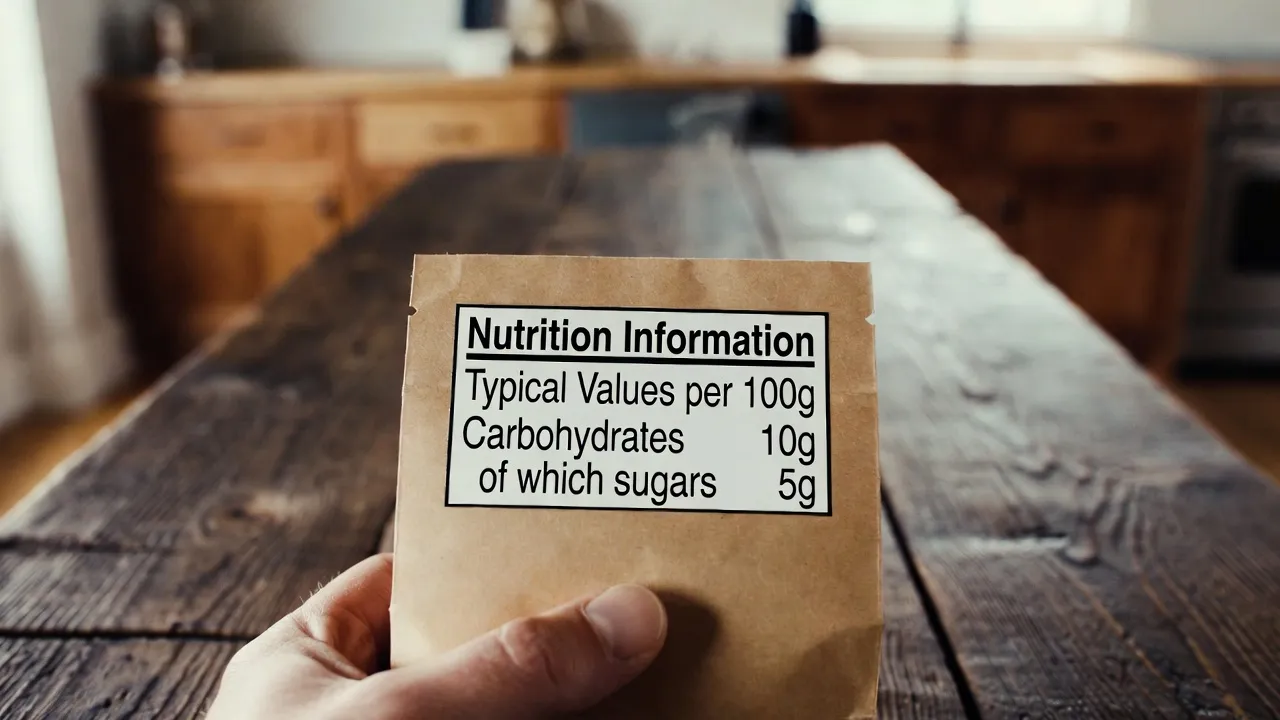
Net Carbs in the UK: Do You Subtract Fibre?
No — and here's exactly why. UK food labels already show net carbs. This guide explains the difference between UK and US labelling, with real product examples and the one exception you do need to watch for.
Low Carb Life
Contributor
Short answer: No. On a standard UK food label, the “Carbohydrates” figure already excludes fibre. You never need to subtract it.
If you’ve been following American keto blogs, YouTube channels, or using US-based tracking apps like MyFitnessPal, you’ve almost certainly been told to “subtract fibre from total carbs to get net carbs.” That advice is correct — but only for US labels. If you apply it to a British label, you’ll get your numbers completely wrong and potentially end up with impossible negative carb counts.
This guide explains exactly why, with real UK product examples and the one important exception you do need to know about.
Why UK and US labels are different
The difference comes down to how each country legally defines “carbohydrate.”
In the UK (and the rest of Europe), food labelling is governed by assimilated EU Regulation 1169/2011. Under this law, “carbohydrate” is defined strictly as carbohydrate that is metabolised by humans. Since your body cannot digest fibre — your small intestine simply lacks the enzymes to break it down — fibre is excluded from the carbohydrate figure entirely. It gets its own separate line on the label.
In the US, the FDA uses a completely different method called “carbohydrate by difference.” They weigh the food, subtract the protein, fat, moisture, and ash, and whatever mass is left over gets labelled as “Total Carbohydrate.” Because fibre has physical mass but isn’t protein, fat, water, or ash, it gets swept into the total. That’s why US labels show fibre indented underneath total carbohydrate — it’s a subset of it.
The whole concept of “net carbs” was invented because American consumers needed a way to undo this regulatory quirk. It’s a mathematical fix for a US labelling problem that simply doesn’t exist in the UK.
How to tell them apart at a glance
The UK low-carb community has a quick rule of thumb that works remarkably well:
- “Fibre” with an ‘re’ → UK/EU label. The carbs figure is already net. Don’t subtract anything.
- “Fiber” with an ‘er’ → US label. You need to subtract fiber from total carbohydrate.
You can also check the panel title. UK labels say “Nutritional Information” or “Typical Values.” US labels say “Nutrition Facts.” If you see “Nutrition Facts” and “Total Carbohydrate,” you’re looking at an FDA-formatted label.
The negative carbs problem
This is the single most common mistake UK keto beginners make, and it crops up constantly on forums like r/ketouk.
Take chia seeds. A typical UK packet shows:
| Per 100g | Value |
|---|---|
| Carbohydrate | 6g |
| Fibre | 35g |
If you follow American advice and subtract fibre from carbs, you get 6 - 35 = negative 29g of net carbs. Obviously that’s impossible. No food cancels out carbohydrates.
The correct reading is simple: chia seeds contain 6g of digestible carbohydrate per 100g. The 35g of fibre is already excluded from that figure. Log the 6g and move on.
Worked examples with real UK products
LivLife Seriously Seeded Bread
| Nutrient | Per 100g | Per slice |
|---|---|---|
| Carbohydrate | 14.6g | 3.8g |
| — of which sugars | 3.2g | 0.8g |
| Fibre | 8.3g | 2.1g |
| Protein | 25.9g | 6.7g |
Your carb count per slice: 3.8g. That’s it. Don’t subtract the 2.1g of fibre — it’s already excluded. LivLife achieves this low figure by using concentrated wheat protein and seeds to physically displace the starch you’d normally find in bread.
BFree High Protein Wraps vs Warburtons Protein Wraps
Not all “protein” products are equal. Compare:
| Nutrient | BFree per wrap (42g) | Warburtons per wrap (62.5g) |
|---|---|---|
| Carbohydrate | 3.5g | 21.1g |
| Fibre | 6.3g | 3.8g |
| Protein | 11.0g | 8.1g |
BFree wraps are genuinely keto-friendly at 3.5g carbs. Warburtons “Protein” wraps contain 21.1g of carbs per wrap — that’s your entire daily allowance on strict keto, gone in one wrap. The “protein” branding is marketing, not a low-carb claim.
Notice that BFree’s fibre (6.3g) is higher than its carbohydrate (3.5g). If you subtracted fibre US-style, you’d get negative 2.8g — another impossible number. The UK label is already correct.
Fage Total 5% Greek Yogurt
| Nutrient | Per 100g |
|---|---|
| Carbohydrate | 3.0g |
| — of which sugars | 3.0g |
| Fibre | 0g |
| Protein | 9.0g |
Dairy products are straightforward — the carbs are entirely naturally occurring lactose, with no fibre in the picture. The 3.0g is what you log.
One thing to watch: if you look up Fage on a US site, you’ll see different numbers. US labels use larger serving sizes (150—170g vs the UK per-100g standard) and FDA rounding rules allow rounding to the nearest whole gram. This makes the same product look nutritionally different across the Atlantic. Always use the figures from the physical UK packet.
The one exception: polyols (sugar alcohols)
Here’s where it gets more nuanced. UK law defines fibre as separate from carbohydrate, but it defines polyols (sugar alcohols like erythritol, maltitol, xylitol, and sorbitol) as carbohydrate. This means polyols are included in the main “Carbohydrate” figure on a UK label.
This matters for products like protein bars, sugar-free chocolate, and keto desserts that rely heavily on these sweeteners.
Grenade Carb Killa bar — a worked example
| Nutrient | Per 60g bar |
|---|---|
| Carbohydrate | 20.0g |
| — of which sugars | 1.3g |
| — of which polyols | 18.0g |
| Fibre | 2.4g |
The headline 20g of carbs looks alarming, but 18g of that is polyols. The remaining non-polyol carbohydrate is just 2g (1.3g sugars plus trace starches).
But not all polyols are equal:
- Erythritol has a glycaemic index of zero — it passes through your body without being metabolised. Most keto practitioners subtract it entirely.
- Maltitol has a glycaemic index of 35—50 and will cause a meaningful blood sugar spike. Treating it as “zero carbs” is a common mistake that can stall weight loss or disrupt ketosis.
The practical approach: check the ingredients list to see which polyol is used. If it’s erythritol, you can reasonably subtract it. If it’s maltitol, be cautious — the NHS DAFNE programme (for Type 1 diabetes insulin dosing) recommends halving the polyol figure as a rough guide to its glycaemic impact.
The bottom line: never subtract fibre from a UK label, but you may need to account for polyols in heavily sweetened products.
What about diabetes and carb counting?
If you’re managing diabetes, precise carb counting directly affects insulin dosing and blood sugar control. Diabetes UK’s guidance is clear: use the main “Carbohydrate” figure from the back-of-pack nutrition grid. Don’t use the “of which sugars” subset (starches raise blood sugar too), and don’t use the front-of-pack traffic light label.
Because UK labels already exclude fibre, the carbohydrate figure is exactly what you need for calculating bolus insulin doses. If you were to subtract fibre following US advice, you’d under-dose your insulin — potentially leading to dangerously high blood sugar.
For products containing polyols, the DAFNE “half rule” (described above) is the standard clinical approach: halve the polyol amount, subtract that from total carbohydrate, and dose insulin on the adjusted figure.
If you’re on diabetes medication — particularly insulin or SGLT2 inhibitors — always discuss carb-counting methods with your diabetes team. This guide is for general information; it isn’t medical advice.
Watch out for imported US products
Amazon UK, specialist health food shops, and online supplement stores regularly sell US-imported products. Sometimes the importer applies a compliant UK sticker over the original label. Sometimes they don’t.
Products that commonly cause confusion:
- Quest Bars — the US label shows ~24g Total Carbohydrate with 14g Dietary Fiber. A correctly applied UK sticker would show ~10g Carbohydrate with 14g Fibre listed separately.
- Lily’s Chocolate — the US packaging prominently prints “net carb” maths on the front (e.g. “8g Total Carbs - 3g Fiber - 4g Erythritol = 1g Net Carbs”). A UK-compliant sticker would show 5g Carbohydrate, because fibre is removed but erythritol stays in under UK law.
If you suspect you’re looking at a US label, check for “Nutrition Facts,” “Total Carbohydrate,” and the spelling “Fiber.” If all three are present, subtract the fiber. If none are present, you’re on a UK label — use the carbs figure as-is.
Quick reference: the rules
- Standard UK product → Use the “Carbohydrate” figure directly. Never subtract fibre.
- UK product with polyols → Check which polyol is used. Subtract erythritol; be cautious with maltitol (halve it as a rough guide).
- US import with original label → Subtract “Dietary Fiber” from “Total Carbohydrate” to get net carbs. Then assess polyols separately.
- Not sure which label format? → Check the spelling. “Fibre” = UK. “Fiber” = US.
Further reading
- What is Low Carb? — Our beginner’s guide to getting started
- The Low Carb Food List — What to eat and what to avoid
- Tesco Low-Carb Shopping Guide — 30 products with full macro breakdowns
Some links in this article may be affiliate links. If you buy through them, we may earn a small commission at no extra cost to you — it helps keep this site free. We only ever link to products we’d actually use.