Best Extra Virgin Olive Oil in UK Supermarkets (2026): A Buyer's Guide
How to spot authentic, high-polyphenol extra virgin olive oil in UK supermarkets — and which bottles to pick up (and which to avoid) from Asda, Aldi, Lidl, Tesco, Sainsbury's, Waitrose, and M&S.
Published Updated
Extra virgin olive oil (EVOO) is the fat of choice on a low-carb or ketogenic diet — not just because it’s zero carbs, but because genuine, high-quality EVOO is one of the most polyphenol-rich foods you can consume. The problem is that the UK supermarket shelf is confusing, pricing has roughly doubled since 2022, and not everything labelled “extra virgin” delivers what it promises.
This guide cuts through the noise. It explains exactly what you’re paying for, which certification marks to look for, which own-brand bottles are genuinely worth buying, and which to leave on the shelf.
What actually makes an olive oil “extra virgin”?
Extra virgin is the highest classification in olive oil grading — and it has two hard legal requirements:
Mechanical extraction only. The oil must be produced from olives via purely mechanical means (centrifugal extraction or traditional pressing) with no chemical solvents and a processing temperature kept below 27°C. Heat increases yield but degrades the polyphenols and volatile aromatic compounds that make EVOO nutritionally valuable.
Zero defects and low acidity. Under International Olive Council (IOC) standards, the oil must have no detectable organoleptic defects and a free fatty acid content (expressed as oleic acid) of no more than 0.8%. Anything above that is virgin or refined olive oil — not extra virgin.
In practice, this means the olives need to be milled within roughly 72 hours of harvest before enzymatic activity begins raising acidity. Delayed processing is one of the most common routes to producing oil that fails the extra virgin threshold, regardless of what the label says.
Why EVOO matters on a low-carb diet
The fat profile of EVOO is primarily oleic acid — a stable, monounsaturated omega-9 fatty acid that provides sustained metabolic energy without triggering significant insulin response. But the more important consideration for health is the polyphenol content.
Polyphenols — particularly oleocanthal and hydroxytyrosol — are the compounds responsible for the peppery catch at the back of your throat when you eat good EVOO. They have well-documented antioxidant and anti-inflammatory properties; oleocanthal in particular has been studied for its inhibitory effect on the same inflammatory pathways targeted by ibuprofen, though it’s not a pharmaceutical substitute.
The practical implication: a flat, greasy oil with no pepper or bitterness has very low polyphenol content, regardless of what the bottle says. The taste test is your most reliable quality indicator.
For raw consumption — on salads, drizzled over cooked food, or as a dipping oil — nutritionists typically suggest around 20ml per day to benefit from these compounds. There’s a persistent myth that EVOO can’t be used for cooking, but authentic high-polyphenol EVOO has considerable oxidative stability. Standard domestic cooking temperatures in a home oven or frying pan won’t approach its true smoke point; the antioxidants in the oil protect it from breakdown under moderate heat.
The fraud and quality problem in 2026
Olive harvests across Southern Europe have been severely hit by climate-driven droughts and heatwaves since 2022. The resulting supply shortage pushed retail prices sharply higher and, predictably, increased the commercial incentive to adulterate or misrepresent products.
The European Union documented a record number of potential olive oil fraud cases in 2024. The UK Food Standards Agency’s National Food Crime Unit named extreme weather events as a primary structural driver of increasing food fraud risk in its 2024 strategic assessment.
Importantly though, a 2024 study run by Yale University’s School of Public Health on behalf of the North American Olive Oil Association — the most comprehensive independent testing programme ever conducted — found no outright adulteration (undisclosed mixing with non-olive seed oils) in the top 15 proprietary retail brands and major supermarket own-brands it tested. Fraud at that scale, it turns out, is concentrated in obscure brands at the very bottom of the market; the products that tested positive for adulteration came from brands occupying the bottom 15% of market share.
However, the same study found that drought-stressed harvest conditions had measurably reduced overall quality across the board. The oil is genuine — but the sensory experience and polyphenol density are lower than historical baselines. This is an argument for buying better oil, not for distrusting the mainstream brands entirely.
The labelling traps to know about
“EU and Non-EU” blends
The most common labelling on UK supermarket standard own-brand EVOO reads something like “Produced using olives from EU and non-EU countries” or “Packed in Spain using oil from EU and non-EU sources.”
This is legally compliant under retained EU Regulation 1169/2011 (now UK law), but it’s deliberately non-specific. It allows the supermarket to dynamically switch sourcing batch-by-batch based on commodity pricing — buying Spanish oil one month, Tunisian the next, Greek the month after. The result is a homogenised, bland product with no regional character and, critically, no guarantee of when the olives were harvested or how long the oil has been in transit and storage before bottling.
These blended, vaguely-labelled products aren’t necessarily fraudulent — they’re simply optimised for cost and shelf stability rather than flavour or nutrition. Treat them as functional cooking oils, not finishing oils.
Misleading origin marketing
A bottle featuring an Italian flag and rustic Italian typography doesn’t mean the oil inside is Italian. Under UK labelling law, origin must be declared accurately — but the country of packing is not the same as the country of origin. An oil can be packed in Italy from bulk oil imported from Tunisia, Morocco, or Turkey and the label can still say “Packed in Italy.” Look for “Product of [country]” or “Olives grown in [specific region]” rather than just a flag.
The Waitrose sunflower oil trap
One specific watch-out: Waitrose stocks both Essential Extra Virgin Olive Oil and a product called Essential Sunflower & Extra Virgin Olive Oil. The packaging is similar. The latter is 85% refined sunflower oil with just 15% EVOO. Check you’re picking up the right one.
How to spot quality on the shelf: a checklist
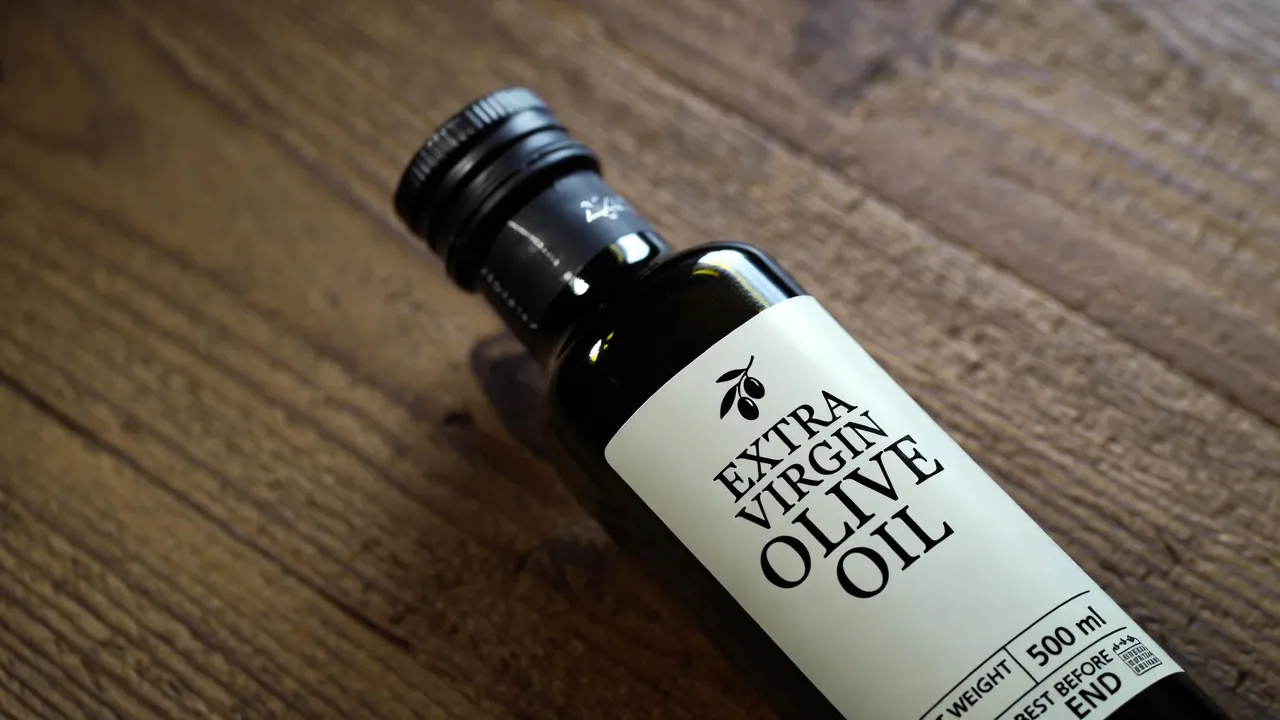
1. Packaging: dark glass or tin only. Olive oil degrades rapidly under UV and visible light — a process called photo-oxidation that destroys polyphenols and eventually turns the oil rancid. Reject any EVOO in clear glass or clear plastic. Dark amber or green glass is fine; opaque aluminium tins are ideal. The harsh fluorescent lighting of a supermarket aisle accelerates this process with every minute the bottle sits on the shelf.
2. Avoid plastic bottles for quality oil. Clear PET plastic poses an additional risk: olive oil is an effective lipophilic solvent, meaning it can leach plasticisers (including phthalates) from the container into the oil. This is a particular concern for endocrine health. For everyday budget cooking oil it may be an acceptable trade-off; for oil you’re consuming raw for its health benefits, it isn’t.
3. Look for specific origin, not vague blends. Single-country or, better still, single-region oils (“Koroneiki olives from Chania, Crete”) are categorically more traceable and consistent than multi-country blends.
4. Check for PDO, DOP, or PGI certification. These are the gold-standard authenticity marks:
- PDO / DOP (Protected Designation of Origin / Denominazione di Origine Protetta): the strongest guarantee. Every batch is tested by an independent government-authorised laboratory before the producer is permitted to use the mark. Each certified bottle carries a unique serial number for full traceability. Producers who tamper with PDO-certified oil face substantial fines and confiscation of their mill.
- PGI (Protected Geographical Indication): slightly less strict — the link to the geographic area must be demonstrated but not every production stage has to occur there. Still a meaningful quality signal.
5. Find the harvest date, not just the best before. Unlike wine, olive oil does not improve with age — it decays. The “best before” date tells you nothing useful; a bottle bottled three years ago with two years remaining is far less valuable than one bottled six months ago. Look for a harvest date or harvest year. Aim to consume EVOO within 12 to 18 months of harvest.
6. Taste it at home. Pour a small amount into a glass, warm it briefly in your cupped hands, inhale the aroma (fresh grass, green tomato, almonds, or artichoke — not stale fat or mustiness), then sip while drawing air through your teeth. A polyphenol-rich EVOO will deliver a distinct peppery catch at the back of the throat — sometimes enough to make you cough slightly. That pungency is oleocanthal. If the oil just feels greasy and flat, the polyphenols are gone.
UK supermarket own-brand ratings
Ratings below draw on independent blind-testing by The Guardian (February 2025), The Independent IndyBest (2026), and Good Housekeeping (2026).
Asda
Asda Extra Special Greek Koroneiki EVOO (500ml) — The Independent’s “Best Supermarket Olive Oil Overall” for 2026. Single-variety Koroneiki olives, fruity notes with a creamy texture, nutty undertones, and a sharp peppery finish. Excellent polyphenol indicator. Recommended as a finishing oil.
Asda Standard Extra Virgin Olive Oil (500ml) — Scored 4/5 from The Guardian. Unexpectedly good for the price: green herb and tomato plant aromas with a persistent pepper note. A solid workhorse cooking oil.
Aldi
Aldi Specially Selected PDO Terra Di Bari Castel Del Monte (500ml) — The standout value pick across multiple testing panels. PDO-certified from Puglia, Italy. The Independent’s “Best Budget Buy”; 75/100 from Good Housekeeping. Big herbaceous aroma, floral flavour, long peppery finish. Strong bitterness makes it excellent for roasted vegetables, pasta, and pesto.
Aldi Specially Selected Toscano PGI EVOO (500ml) — 80/100 from Good Housekeeping. PGI-certified Tuscan oil with buttery aromas, citrus undertones, and a lasting pepper finish. Well-balanced for everyday cooking.
Aldi Solesta Extra Virgin Olive Oil (1L) — Labelled as “produced in Spain using EU extra virgin olive oil” — a blended origin product. Light, nutty, and slightly leafy. Functional cooking oil at a good per-litre price, but not a finishing oil.
Lidl
Lidl Deluxe Premium Puglian EVOO (500ml) — 3/5 from The Guardian. Grassy bitterness present but tasters noted a faint metallic note, which suggests possible oxidation or processing stress. Fine for complex cooked dishes where the flavour is masked by other ingredients; not ideal raw.
Lidl Deluxe Greek Chania Kritis EVOO (500ml) — Made with Koroneiki olives from Chania, Greece, with positive reviews from Which?. A more reliable choice than the Puglian Deluxe.
M&S
M&S Italian Extra Virgin Olive Oil (500ml) — 3/5 from The Guardian: “distant and a bit vague”, with pleasant fruity notes but lacking the polyphenol pungency you’d expect at this price. Adequate for cooking.
M&S Unfiltered EVOO (500ml) — 74/100 from Good Housekeeping. Unfiltered oils retain suspended olive particulates and tend to have higher polyphenol retention. Herbal, mineral, with ripe avocado notes and a creamy bitterness. Better choice than the standard Italian option.
M&S Collection Nocellara del Belice — The premium pick from M&S, using the buttery Nocellara Sicilian varietal. Positive from Which? testing. If you’re buying M&S specifically, this is the one to reach for.
Sainsbury’s
Sainsbury’s Taste the Difference Toscano EVOO (500ml) — 4/5 from The Guardian, “Best Splurge” pick. Rich butter and walnut flavour, grassy notes, and an assertive peppery throat catch that signals high polyphenol content. Ideal for bean soups, potatoes, and salads where the oil is the flavour.
Sainsbury’s Standard Extra Virgin Olive Oil (1L) — Blended Spanish/EU sourcing, frequently packed in clear PET plastic. Functional cooking oil; avoid using raw for maximum nutritional benefit.
Tesco
Tesco Finest Sicilian Extra Virgin Olive Oil (500ml) — 4/5 from The Guardian. Intensely green and herbaceous despite a deep golden colour; strong almond and bitter herb notes with a satisfying throat catch. Non-delicate character makes it excellent for tomato sauces, anchovy dishes, and robust fish cooking.
Tesco Standard Extra Virgin Olive Oil — Broad, homogenised sourcing. Functional cooking oil in line with other supermarket standard ranges.
Waitrose
Waitrose Duchy Organic Spanish EVOO (500ml) — The Independent’s “Best Mild Olive Oil”. Smooth, light, and fresh with a tomato aroma and delicate floral notes; very gentle pepper finish. The choice for those who find high-polyphenol oils too aggressive. Excellent for bread dipping and delicate salads.
Waitrose No.1 Valli Trapanesi (500ml) — PDO-certified from the Trapanesi Valleys in Sicily. 78/100 from Good Housekeeping. Rich, velvety, and notably creamy with a complex peppery finish. The premium choice in the Waitrose range.
Independent brands stocked in supermarkets
These are available via the supermarket own shelves or their online stores:
| Brand & Product | Rating | Notes |
|---|---|---|
| Gaea Kalamata EVOO (500ml) | 89/100 (Good Housekeeping — Best Overall) | PDO Koroneiki. Intense woody, rosemary, and walnut aromas. Buttery texture, robust pepper. Elite polyphenol indicator. |
| Odysea Organic Greek EVOO (500ml) | 81/100 (Good Housekeeping) | Chania, Greece. Complex apple, citrus, and tomato leaf notes. Thick, savoury, and bitter. |
| Belazu Early Harvest EVOO (500ml) | Best for Bold Flavour (IndyBest) | Early-harvest Spanish Arbequina — picked before full ripeness for concentrated flavour and higher polyphenols. Very transparent provenance. |
| Farchioni Il Casolare (500ml) | 4/5 Guardian (Best All-Rounder) | Unfiltered Italian. Silky, with artichoke and olive notes. Versatile for cooking and finishing. |
| Filippo Berio Organic (1L) | Best for Everyday Use (IndyBest) | Italian/Spanish/Tunisian blend. Grassy and nutty. Note: the standard (non-organic) Filippo Berio scores significantly lower — 3/5 for lacking freshness. Buy organic if buying this brand. |
| Napolina Extra Virgin (500ml) | 1/5 (The Guardian) | Heavily criticised by sommeliers — “fatty and sleepy” with virtually no olive flavour. Avoid. |
The bulk-buying alternative
A growing number of UK consumers are bypassing supermarkets entirely and buying 3-litre or 5-litre opaque aluminium tins from Greek, Turkish, or pan-Mediterranean specialist grocers, or from wholesale suppliers like Costco (which stocks a well-regarded 100% Spanish EVOO under the Kirkland Signature label).
This approach offers three advantages: significantly lower cost per litre, better protection from light degradation (tins are completely opaque), and often better provenance (specialist suppliers are more likely to carry single-estate, single-harvest oils).
If you have a Greek or Turkish grocery near you — common across London and most UK cities with diverse food retail — it’s worth asking the staff what they buy themselves. The answer is usually in a large tin, and it’s usually very good.
Quick reference: what to buy at each supermarket
| Supermarket | Best Choice | Why | Price |
|---|---|---|---|
| Asda | Extra Special Greek Koroneiki | Single-variety, strong polyphenol indicators, best overall value | Check |
| Aldi | Specially Selected PDO Terra Di Bari | PDO-certified, exceptional value | Check |
| Lidl | Deluxe Greek Chania Kritis | More consistent than the Puglian Deluxe | Check |
| M&S | Collection Nocellara del Belice | Premium Sicilian varietal | Check |
| Sainsbury’s | Taste the Difference Toscano | High polyphenol, strong flavour | Check |
| Tesco | Finest Sicilian | Bold, herbaceous, great for cooked dishes | Check |
| Waitrose | No.1 Valli Trapanesi (premium) or Duchy Organic (mild) | PDO or clean single-origin | Check |
“Check” links open the retailer’s own search for the product — prices and availability vary; check there.
Ratings from The Guardian (February 2025), IndyBest (2026), and Good Housekeeping (2026). Prices are deliberately not listed — olive oil pricing has been volatile since 2022; check the retailer.
Key takeaways
- The carbohydrate content of extra virgin olive oil is zero — it’s pure fat. It fits every low-carb and ketogenic eating pattern.
- Polyphenol content (the source of the peppery throat catch) is the primary quality differentiator. High polyphenols = good oil. Flat and greasy = poor oil.
- PDO and PGI certification marks are the most reliable authenticity signals in a supermarket aisle.
- Avoid clear glass and plastic packaging for oils you’re consuming raw — dark glass or tins only.
- Look for a harvest date. Best-before dates are not a useful quality indicator for olive oil.
- “EU and Non-EU” blends are functional cooking oils, not premium finishing oils.
- At supermarket level: Aldi’s PDO Terra Di Bari is the outstanding value pick; Sainsbury’s Toscano and Tesco Finest Sicilian are the best premium own-brands.
Further reading
- What is Low Carb? — Our beginner’s guide to getting started
- The Low Carb Food List — Fats and oils to eat and avoid
- Seed Oils Guide — Why olive oil beats the alternatives
- Aldi Low-Carb Shopping Guide — Budget discounter staples
- Lidl Low-Carb Shopping Guide — Lidl supermarket walkthrough
Product availability last checked March 2026. If you notice a product has been discontinued or reformulated, please let us know.